




Koolan Island iron ore mine is a celebrated part of WA’s mining history but plans for its rehabilitation and the island’s future are well under way.

THE state’s resources sector has a reputation for project rehabilitation that could best be described as patchy, in no small part courtesy of the deadly Wittenoom asbestos mines.
But there are success stories, too.
For example, KCGM-backed Kalgoorlie-Boulder Urban Landcare Group’s rehabilitation of a heavily prospected gold field into recreational bushland in Kalgoorlie-Boulder; BHP’s Beenup mineral sands site near Augusta; and Mount Gibson Iron’s effort with its first mine, Tallering Peak.
That result is one Mount Gibson hopes to repeat as it works with traditional owners and other stakeholders to decide what is next for Koolan Island.
Established in 1959 by BHP, the iron ore mine at Koolan Island was one of Australia’s first.
It is noteworthy for its high-grade ore body, which attracts a price premium over most of what is mined in Western Australia.
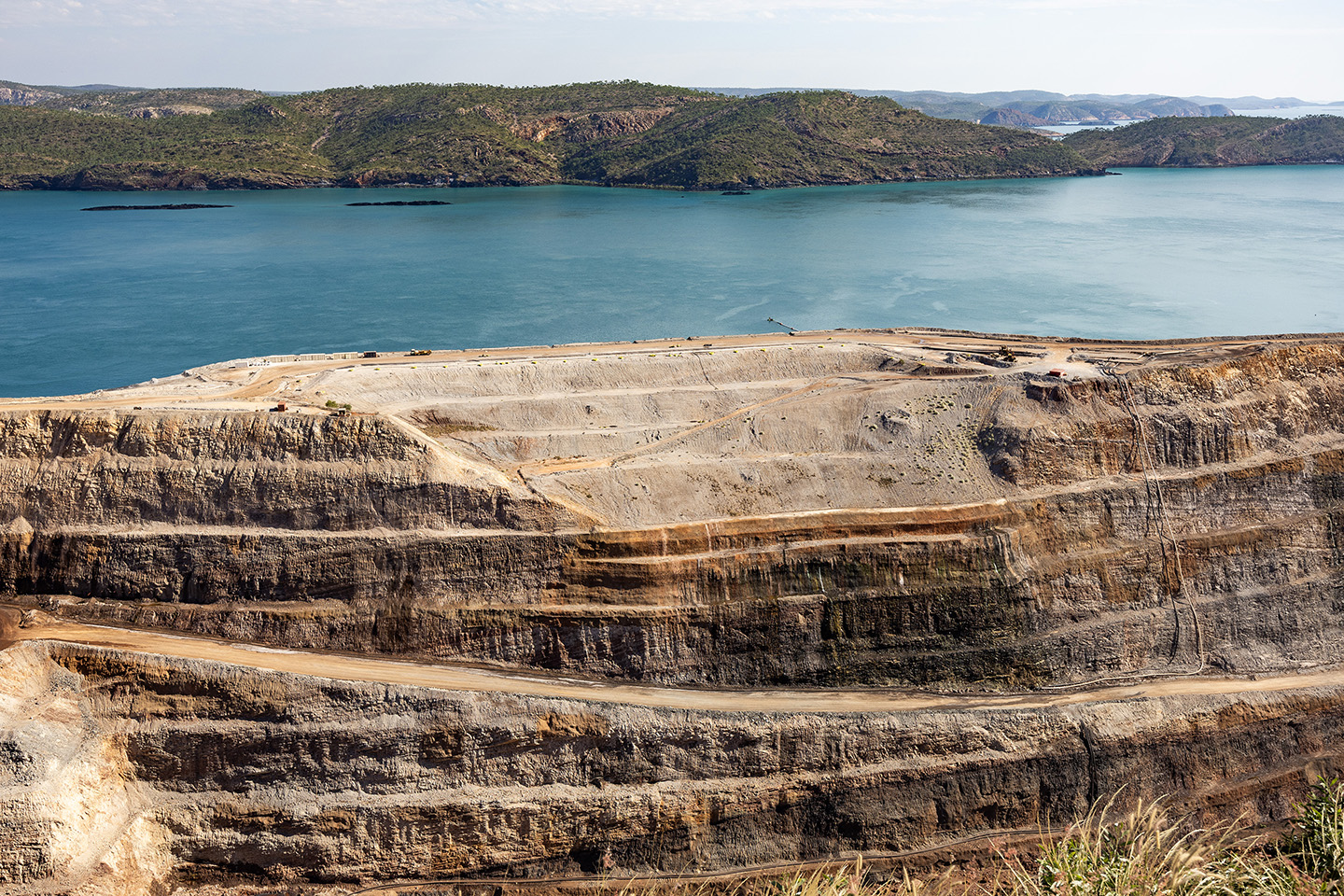
It is an operation unlike any other: the mine straddles the edge of a remote Kimberley island with only its seaward wall keeping the tropical ocean and saltwater crocodiles out of the pit, which sinks 180 metres below the mid-tide.
A popular destination for workers even today, the island has become part of the sector’s folklore, particularly among those who lived there during its residential days.
Running and walking tracks are well used, fishing rods are sold from the general store for those on downtime, and the food service has been lauded since Mount Gibson took operations in-house.
“The people behind the kitchen, people in the catering, and in the camp sites are all Mount Gibson personnel,” Mount Gibson chief executive Peter Kerr said.
“As a result, the care factor and the real effort that’s gone into it has been really good.
“It is a definite improvement as far as food quality, cleanliness and the camp, ownership, team atmosphere.
“The key [benefits] are generally the team nature on the island, the environment there, and the fact that if you’re in any part of mining, you can have a lot of involvement in a whole bunch of challenges.”
But mining is expected to end within the next three years as Mount Gibson reaches the limits of the open pit, which several staff and executives described to Business News as ‘more like a goldmine’.
The winding-up of Koolan Island’s mine begs two questions: what next for the island, and what next for the company?

Current ops
Koolan Island has been busy in recent months and the camp almost at capacity.
About 360 people are on the island, well above steady-state operations of about 300 personnel.
Several mine projects have contributed to that, chief among them an $8 million tertiary crusher due to come online in July.
“We can make fines, which is the high-grade sand-like iron ore, and that is what we’re selling at this point,” Mr Kerr said.
“We also have in the pit at times … material that is a bit harder, which tends to create oversize and lump.
“Up till now, what we have been doing is crushing that through a portable crusher.
“We have been using the services of MLG and they have done well for us, but they will finish up at some point.
“The tertiary circuit, it’s not a whole crushing circuit in its own right, it’s a bolt-on.
“What it’s designed to do is to take that oversize material and crush that down.”
Mr Kerr said the miner expected the tertiary crusher would have a short payback period of one year, which had justified the investment.
The next big project is the final switchback in the main pit to unlock the east end of the mine.
Once that is opened, mining toward the eastern boundary is expected to sustain the operation until it wraps up in the next three years.
“The western half, which is the deeper part at the minute, we are mining the last bit out,” Mr Kerr said.
“Very soon we will be out of there.
“Close to the middle we will actually build a switchback to the ramp and divert the ramp back to the eastern end, which is over 100 metres higher.
“The eastern end will be the mining base and the ore supply for the next few years, and the western end in effect becomes a water sump where we will manage the water flows in the pit.”
He said the mine’s closure timeline would not be substantially altered by any new life breathed into the operation via two satellite deposits.
As for never-ending chatter about the potential to mine under the ocean floor, where the rich vein of iron ore continues, Mr Kerr said it was enticing but not likely viable at this stage.
“We are talking to some people about what could be involved,” he said.
“The ore body is very friable, so it breaks down quickly. There is a water flow through it, which is natural groundwater.
“How much do you need to leave behind in the form of pillars and, therefore, what is your extraction ratio and is it economically viable?
“BHP looked at underground, we have looked at it, and it’s always been a question mark, but I think so far we’ve dismissed it.”

Island rehab
With the mine’s closure looming, Mount Gibson staff are busy figuring out how best (and to what extent) to return the island to its natural state.
Rehabilitation and monitoring has already been a part of the story on Koolan Island – some of BHP’s former operations have been remediated – and work on current assets will begin while the mine is still open.
Mr Kerr said Mount Gibson was working with Dambimangari traditional owners to plan for life beyond mining at Koolan Island.
“The main unknown at this point is to what extent is it best to leave infrastructure there for other uses post-mining?” he said.
“That in particular is focused on the wharf and jetty, the camp and the airstrip.
“We know there are parties in government, defence forces and other industrial and oil and gas companies that are very keen to do things there.”
A key piece of work is centered around how to ensure traditional owners can use the island for commercial and cultural purposes.
A cultural centre has already been built, but much more work is needed.
One option could come from an arrangement usually well outside a miner’s remit: partnering with traditional owners in a non-mining business.
“We hope to partner with them, and they would like to partner with us in doing something post-mining, continuing that relationship,” Mr Kerr said.
“We have got an open mind on it, we have talked about a number of possible structures, but we will still need to do the rehab required and we’re not running away from that.
“At the same time, you could have other businesses operating there that actually help the rehab cost, help the people, and help the traditional owners in terms of what they want to do.”
When it comes to rehabilitation, Mount Gibson does have credit to draw on from the work to remediate its first mine, Tallering Peak near Geraldton.
That rehabilitation was completed in 2015 and the company is ready to return the mining leases.
Mr Kerr said Koolan Island represented an opportunity to go one step further by building a new economy in the area.
“If you could build on Koolan Island some industrial businesses, whether that’s defence related or oil and gas or something else, and then add to that a tourism business, then there’s an obvious central point there,” he said.
“Royal Flying Doctor Service support can also be there [and] you could do more things with tourism and Horizontal Falls.”
The presence of RFDS and Mount Gibson medical team at the island’s airstrip has been of benefit in recent years, most notably in 2022 when it was used to transport those injured in a tour boat accident at Horizontal Falls.
One other factor is the broader importance of Koolan Island as an ark for threatened species. The local northern quoll population is booming on the island, which is being used as a fortress for the marsupial against the march west of the cane toad (now in Derby).

Company pivot
The end of Koolan Island isn’t just a land rehabilitation story; it also leaves Mount Gibson without a mine to pin its flag to.
Mount Gibson divested from its Mid West mines in 2023 and has no active projects on its books outside of Koolan Island.
But the miner is working in the background to change that.
“What our key shareholders want to do is use the next few years to add something to the business,” Mr Kerr said.
“That is difficult, so we have basically been making those efforts to see what we can do.”
The potential tie-in with traditional owners on a non-mining venture is one avenue Mount Gibson is exploring.
Others more closely align with the company’s bread and butter.
“We have made investments in about six or seven junior companies, and we haven’t been public about that,” Mr Kerr said.
“Those investments are small, and we have sold out of two or three.
“We are there because we like what the teams are doing with them, and it can lead to financing or joint venture discussions … something that maybe sees a bigger partnership occur in the future.”
He said Mount Gibson was focusing on in-production or near-production assets in copper, lead, zinc, and iron ore.
Coking coal was also listed, though Mr Kerr said the miner had not had a close look at the sector for some time.
Outside of acquiring assets, mergers are also on the table.
Mr Kerr said the company had approached and been approached by interested parties.
Any decisions on the future, he said, would be made with a view to what was best for the company in 10 to 15 years’ time.
Mount Gibson’s inevitable winding back of its Kimberley presence will have another ripple, too, in the form of community sponsorship.
The miner aims to reinvest about $500,000 a year into communities, mainly Derby, a number Mr Kerr admits Mount Gibson has fallen short of in recent years due to tight profit margins.
“We are trying to build it back up a little bit in the next year or two,” Mr Kerr said.
“Depending on what happens with Koolan and other activities, we would like to leave the things we support in a sustainable form.
“That might mean other companies coming in and taking our place, or at least us working with them to try to find a way of setting them up.”
Mount Gibson’s local support focuses on youth, education and community groups, alongside its backing of Lifeline, the RFDS, Foodbank, Clontarf, and the Shooting Stars.
Mr Kerr said developing measures to ensure life beyond the mine for Koolan Island and Mount Gibson would be among his key concerns in coming years.


